
It is by imagination that knowledge is “carried to the heart” (to borrow again from Allen Tate). The faculties of the mind — reason, memory, feeling, intuition, imagination, and the rest — are not distinct from one another. Though some may be favored over others and some ignored, none functions alone. But the human mind, even in its wholeness, even in instances of greatest genius, is irremediably limited. Its several faculties, when we try to use them separately or specialize them, are even more limited.
The fact is that we humans are not much to be trusted with what I am calling statistical knowledge, and the larger the statistical quantities the less we are to be trusted. We don’t learn much from big numbers. We don’t understand them very well, and we aren’t much affected by them. The reality that is responsibly manageable by human intelligence is much nearer in scale to a small rural community or urban neighborhood than to the “globe.”
When people succeed in profiting on a large scale, they succeed for themselves. When they fail, they fail for many others, sometimes for us all. A large failure is worse than a small one, and this has the sound of an axiom, but how many believe it? Propriety of scale in all human undertakings is paramount, and we ignore it. We are now betting our lives on quantities that far exceed all our powers of comprehension. We believe that we have built a perhaps limitless power of comprehension into computers and other machines, but our minds remain as limited as ever. Our trust that machines can manipulate to humane effect quantities that are unintelligible and unimaginable to humans is incorrigibly strange.
As there is a limit only within which property ownership is effective, so is there a limit only within which the human mind is effective and at least possibly beneficent. We must assume that the limit would vary somewhat, though not greatly, with the abilities of persons. Beyond that limit the mind loses its wholeness, and its faculties begin to be employed separately or fragmented according to the specialties or professions for which it has been trained.
[…]
No doubt there always will be some people willing to do anything at all that is economically or technologically possible, who look upon the world and its creatures without affection and therefore as exploitable without limit. Against that limitlessness, in which we foresee assuredly our ruin, we have only our ancient effort to define ourselves as human and humane. But this ages-long, imperfect, unendable attempt, with its magnificent record, we have virtually disowned by assigning it to the ever more subordinate set of school subjects we call “arts and humanities” or, for short, “culture.” Culture, so isolated, is seen either as a dead-end academic profession or as a mainly useless acquisition to be displayed and appreciated “for its own sake.” This definition of culture as “high culture” actually debases it, as it debases also the presumably low culture that is excluded: the arts, for example, of land use, life support, healing, housekeeping, homemaking.
I don’t like to deal in categorical approvals, and certainly not of the arts. Even so, I do not concede that the “fine arts,” in general, are useless or unnecessary or even impractical. I can testify that some works of art, by the usual classification fine, have instructed, sustained, and comforted me for many years in my opposition to industrial pillage.
The excerpts come from Wendell Berry’s 2012 Jefferson Lecture (full text), and the message is fresh even a decade-and-a-half later. Berry composed his words when Youtube was seven years old, the iPhone was five years old, cloud computing was in its infancy. Facebook, begun in 2004 and revamped in 2005, was hoovering up personal data. But, looking back to 2012, the scale of tech seems, well, rather quaint and even relatively unobtrusive. Such comparisons, of course, become ridiculous once the scales are gauged as “then merely humongous” and “now obscenely galactic” (mind you, that’s my terminology).
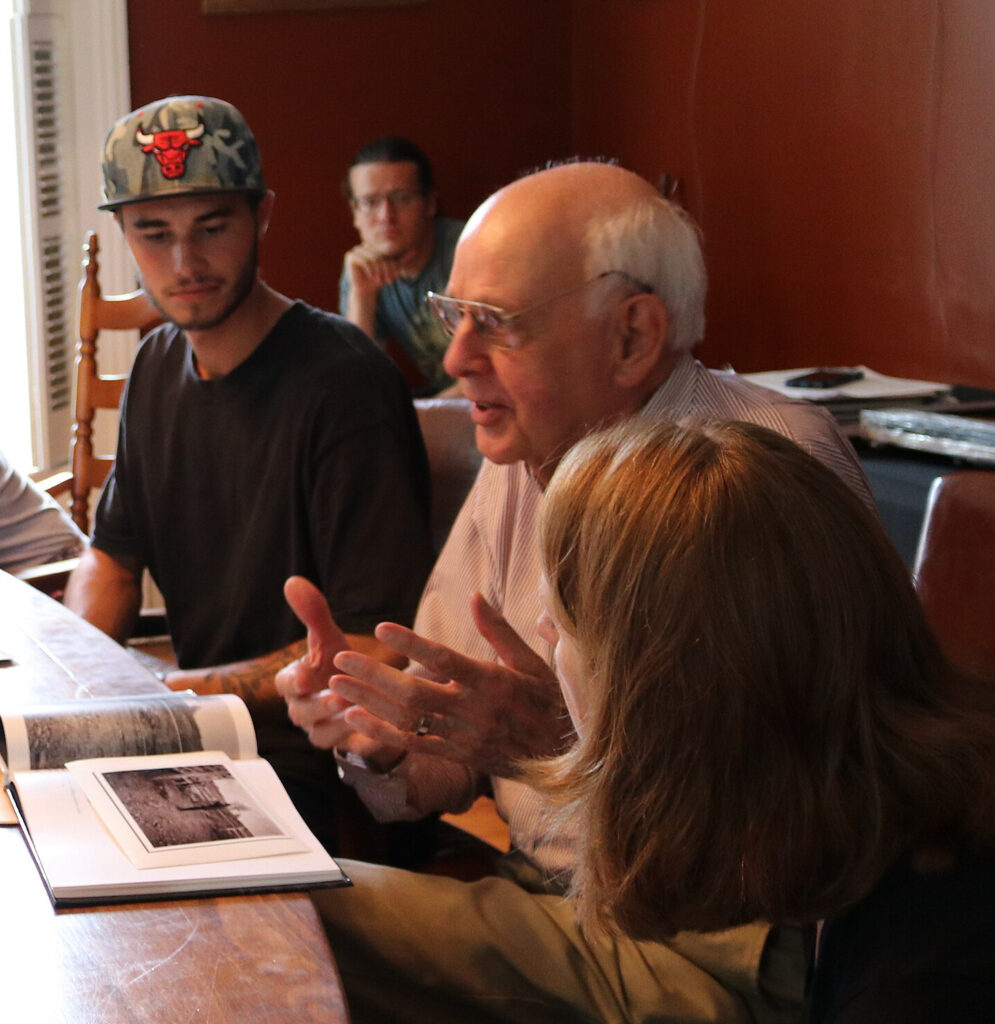
In 2012 Berry correctly observed that “there always will be some people willing to do anything at all that is economically or technologically possible, who look upon the world and its creatures without affection and therefore as exploitable without limit. Against that limitlessness, in which we foresee assuredly our ruin, we have only our ancient effort to define ourselves as human and humane.” His judgment stands today in 2026.
City dwellers have trouble with Berry because they think his thought applies only to rural life. It’s a reasonable objection, I suppose; I thought that way when I first read some of his work. The notion of scale and the core thinking in his Jefferson Lecture apply to all kinds of human communities, though. He defines humanly managable scale as a “small rural community or urban neighborhood.” But an expansion “to the ‘globe’ “? Forget about it. The thought boggles the Internetted city dweller or even the small town grocery shopper who delights in the Mandarin orange imported last week from Mexico or the plump strawberries from South America. Even the smallish gestures in the produce aisle reach across the world. Berry asks us to rethink, and change in ways that inevitably reduce the reach — and likely the variety that we’ve become accustomed to.
That’s the conflict I struggle with, even as I see the logic and justice that Wendell Berry describes and argues for.
Image credits:
Quinn Dombrowski from Berkeley. Smith vs Marx vs Wendell Berry. March 22, 2011. Smith vs Marx vs Wendell Berry. https://commons.wikimedia.org/wiki/File:Smith_vs_Marx_vs_Wendell_Berry_(5566296465).jpg. Rights: CC BY-SA Generic (2.0).
Sterling College from Craftsbury Common, VT. The Wendell Berry Farming Program of Sterling College. September 6, 2018. Digital photograph. WBFP_4116. https://commons.wikimedia.org/wiki/File:WBFP_4116_(39750972413).jpg. Rights: CC BY-SA Generic (2.0).



.jpg)
.jpg)