There are two kinds of beauty in the world, one dominant in the cultural imaginary, and the other just as common in the world but neglected in the eyes of official art culture. Let’s call them object beauty and process beauty. Object beauty is the familiar kind—the beauty of painting, movies, ballet, novels, and rap. It’s what we usually think about when we think about art. It’s the beauty that’s in the art object itself. It’s the movie that’s bittersweet, the novel that’s inventive and weird.
Process beauty is different. It is the beauty of your own actions and choices. There is no easy line between a beautiful thing and the observer of beauty, between object and audience.
Process beauty is everywhere. Sometimes it happens spontaneously and accidentally. When you open a cupboard and a glass falls out and somehow you sweep your hand under it and catch it with a graceful little motion—it is your body, your movement that is graceful. But other times, we design artifacts specifically to get us there, to encourage and sculpt beautiful action. This is process art. And games are often designed to encourage and shape our action into something more beautiful, more thrilling, more funny. Games help us find our way into actions worth savoring. (p. 95)
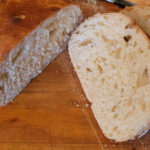
I’ve been reading C. Thi Nguyen’s The Score: How to Stop Playing Somebody Else’s Game (Penguin, 2026) which I think I’ll be reviewing in coming weeks. Along the way in the kitchen, I’ve been perfecting my somewhat baguette-y “perfect bread recipe.” I have discovered that process is the most important aspect of perfection, at least for bread baking. The Score focuses on the uses and misuses of data, those abstracted elements of life that are reduced and simplified into numbers or very clearly defined values. Those “metrics” bend human attention to the final outcomes—the products—of processes. Recipes list steps to get to an outcome, and by doing so, reduce processes to mere algorithms.
True, the completed dish can be “object art.” But as Nguyen observes, we spend a great deal of time on the processes of cooking and relatively little time eating its products.
Shouldn’t we cultivate the process art in our lives? Enriching nuance. Building skill, Developing new sensitivity.
A side note:
Social media and other algorithmic apps have created interfaces—means of access and manipulating something through an app. For about the past decade (I’d say), the “side” that is using the interface has profoundly shifted. Users think they are using the interface to access the features of a social media platform, but they are mistaken. In reality, the platform—the companies, the advertisers, the “tech bros”—are using the app as an interface to access and control the users. Users may believe that the platform has conformed itself to their wishes and their interests, when in reality the algorithms and the platform has shaped—I’d say quite profoundly—the wishes and desires of those using the platform.
Abundant, though simplified, data fuels this reversal of who’s-using-whom. Our complex lives become manipulated and pressed into abstracted scores.