A couple readers noticed that comments were off last week. I had already forgotten to flip the switch on comments for an earlier post, and so it appeared a mistake. But it wasn’t a mistake; I turned off comments on purpose. I do really like to see comments on my posts — all writers’ psyches get stroked when there’s reason to believe someone actually read their words. The thing is, I really needed to focus on other matters of prose, and checking to see if there’s a comment or responding to one distracted my attention.
I have a host of options for procrastination, just like every other newsletter writer using Substack. There are cereal boxes to be read (as Paul Rudnick reminds us). A stroll around the yard sounds good. How about a snack? Other procrastination opportunities disguise themselves as honest writerly work, too. I have a theory that some of the posts we see around Substackia are actually products of honest writerly procrastination. They’re all about writing — how hard it is, getting more readers/subscribers, finding ideas and capturing them for later use. Posts on the topic of not having anything to write about.
You can practically see the blank page on the writers’ desks, defiantly unmarked and shaming, shaming! the writer, who sits with hovering and hesitant pen (or, for keyboardists, hesitant fingers).
This post, I guess, is my addition to the genre, which I will name procrastiprose. Definition below. I guilted myself into writing it, because I am actually to blame for my procrastination. Even though I intended virtue — that is, eloquent and flowing words — I ended up with vicious word-counting and duck-taped “prose.”
I think a metaphorical measure might work to keep my bearings through the project though. More on that later in the post.
Goodhart’s Law in writing life. Maybe a bad idea?
You have no doubt heard of the law. Charles Goodhart created the law. “Any observed statistical regularity will tend to collapse once pressure is placed upon it for control purposes,” he rather obtusely wrote. He was an economist, remember, and the sentence appeared in an article about monetary policy, so give him the benefit of the doubt. Famed anthropologist Dame Marilyn Strathern uttered a more memorable and succinct expression of the law: “When a measure becomes a target, it ceases to be a good measure.”
I committed my Writerly Original Sin when I decided to count words and imagine that their increase also meant progress. Wrong move.
It all began innocently enough. I wanted to plan a pace of writing that would land me what Anne Lamott called the “shitty first draft” (a technical term, by the way). I wanted to have it by the end of May 2023, too, since I need time to obsess about my fall seminar through the summer. (Actually, I don’t need to obsess, but I do nonetheless.) I would count words and, secondarily, pages (12-point New Courier font, double-spaced, one-inch margins).
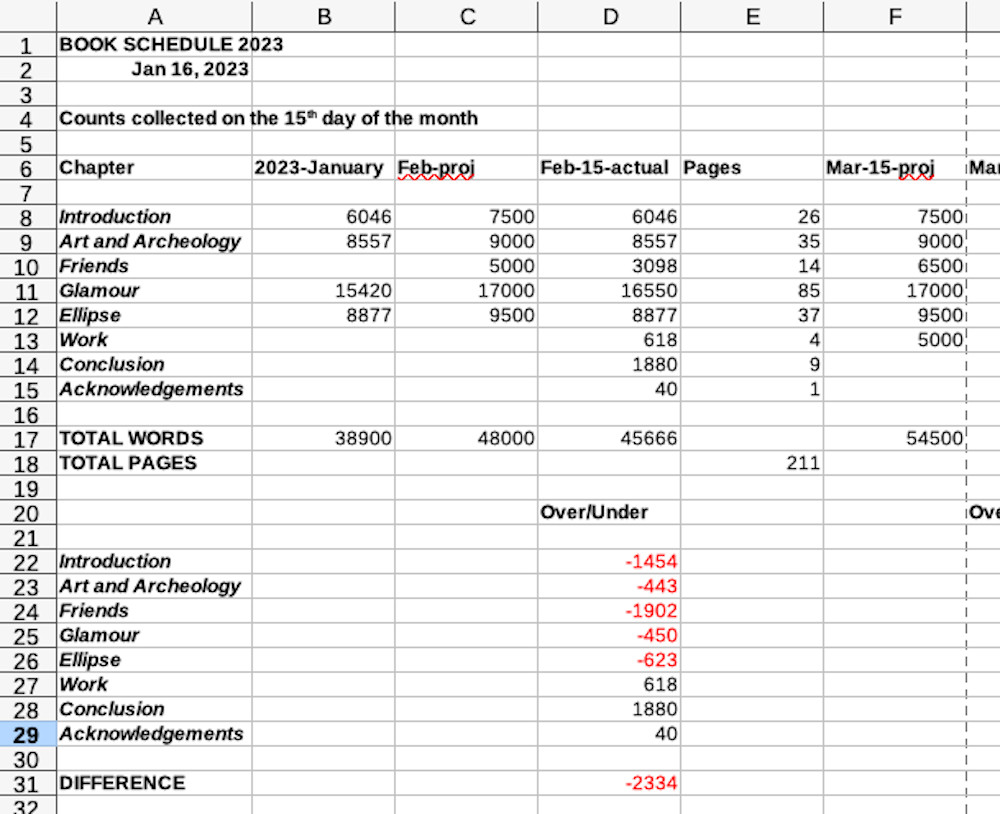
Almost instantaneously, writing changed. The measure became the target. I began to think of the prose as a bag of words rather than a story or an argument. I raked in pieces of newsletter posts that I’d drafted mindful of a place in the book project. That worked to add to the word count, but I found myself less interested in the more delicate and very necessary work of stitching prose patches into a coherent and solid fabric. On February 13, two days before my day of reckoning for the month, I see red negative numbers — deviations from my prospective word counts, deviations that I expected, I should say. The one red number calculates “DIFFERENCE.” It stands at -2334, and it bothers me.
For me and most of the other writers I know, writing is not rapturous. In fact, the only way I can get anything written at all is to write really, really shitty first drafts.
—Anne Lamott
I’m wondering if my attempt to quantify writing output will yield little more than a shittier shitty first draft.
One thing I’ve learned: Writing defies numerical compressions like word counts. That said, I am going to roll up my pants legs to avoid the dreck and continue with the spreadsheet, just to see if my agitation settles into a more prose-friendly level. I’ll also rebalance the prospective word counts for March 15, since I worked on sections I hadn’t planned.
Can my writerly sin be atoned with another month of persistence with numbers? Or will it deepen into a more despairing circle of Goodhart’s Hell?
Goodhart’s Law allayed with river flows?
I saw my debased writerly fallenness a few days into my spreadsheet quantifications, and I began to wonder about a way to redemption. However, when it comes to giving up the spreadsheet and its numbers, I continue to be like St. Augustine who begged God to “make me chaste and celibate … but not just yet.” I’m still not convinced that giving up word counts will really be necessary, not that I’m enjoying being quantified as much as Augustine probably enjoyed not being chaste.
One night, I thought about new models for managing, or at least understanding, my writing process and — importantly — finding means to gauge and encourage progress with my large writing task. For my students, I’d always been careful to build writing assignments that were additive. They proceed toward greater depth and complexity, finding a new skill and confidence. I needed something like that for myself — a means of navigation and guidance, but I couldn’t have the strict deadlines that seemed to work for my students. I knew I’d either blow them off (likely) or they’d warp my writing practices (also likely, as I’d experienced already).
In bed around three in the morning, I dreamily thought about two rivers: the Nile and the Mississippi, their sources and curves, their eventual ends in deltas. With all their distinctive qualities, their changes, and their meanderings, could rivers become a qualitative measuring device for the also meandering prose project? A sort of measuring stick by analogy? Rivers begin with different qualities, run long stretches of moving waters, and often settle into a confusing and somewhat torturous finish in a delta.
Sounds a lot like writing, I thought.
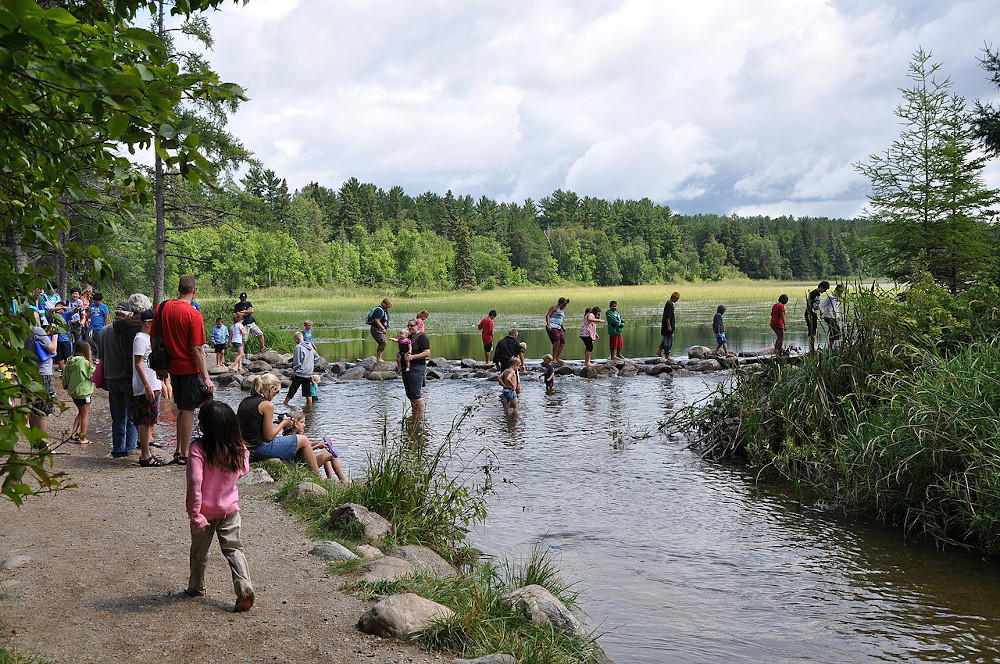
There’s a good chance that I walked across the Mississippi in bare feet and shorts. I grew up in central Minnesota, the “Land of Ten Thousand Lakes,” as the state’s license plates announce. One of them is Lake Itasca, the source of the Mississippi where its first waters spill through stepping stones at one end of the lake. The mighty river has a gentle beginning of constant flow “from the land of sky-blue waters.”
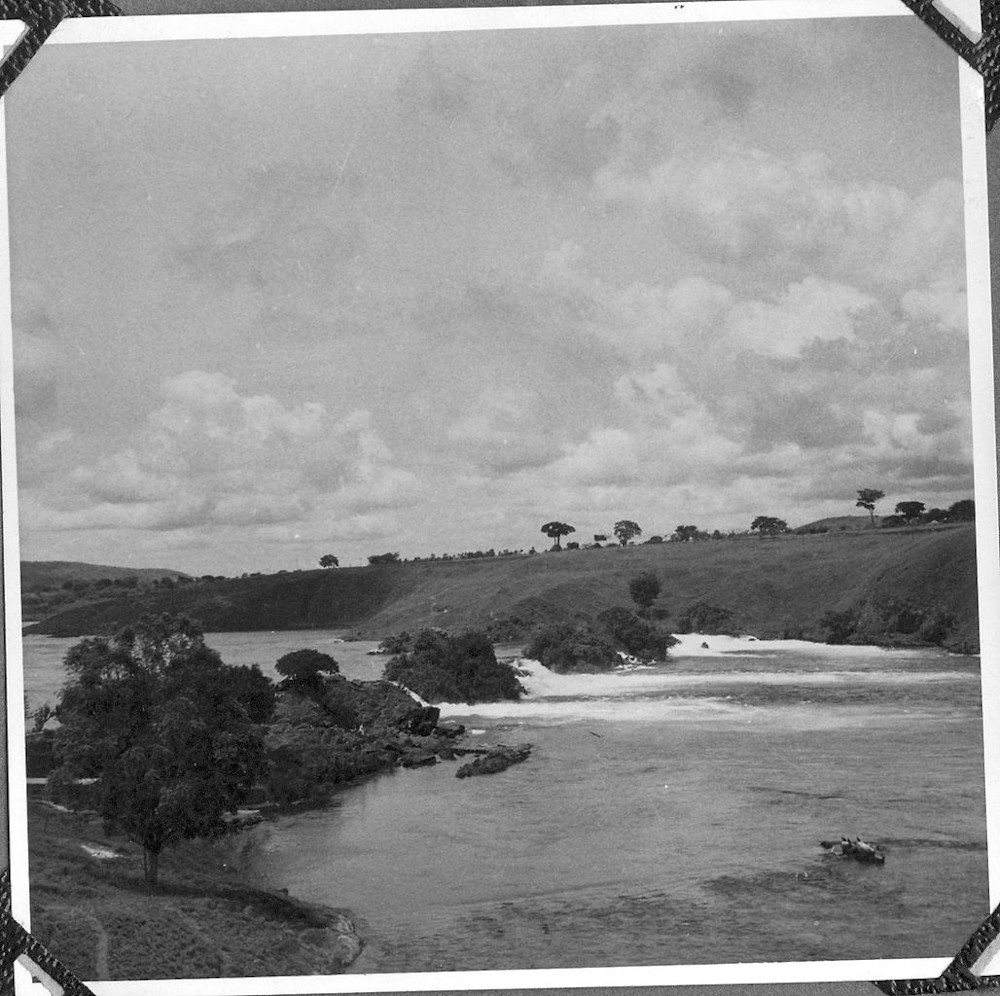
I’ve never been to the headwaters of the Nile; I’ve never even been in Africa, unfortunately. The Nile also begins as an outflow from a lake, and its source was long disputed until someone decided to travel around Lake Victoria to see if there were any inflows that indicated another source. Henry Morton Stanley went around the entire lake and reported the outflow at Ripon Falls, which was considered the source of the Nile before a dam submerged the falls. It wasn’t the tranquil beginning that you see in Minnesota’s Lake Itasca. It was bold and frothy and lacked a walkway for children with bare feet.
Dramatic beginnings give way to flows, some wide and seemingly motionless and others narrow and deep with currents that churn and propel you downstream. I read somewhere that the Mississippi flows about 2,300 miles and over that length drops just about 1,500 feet, a “grade” of about 0.01 percent. It’s a very gentle incline from the sea-level waters of the Gulf of Mexico to cold and clear Lake Itasca far to the north.
The Mississippi River Delta reaches into the gulf, like a bird’s foot extending into the salt water. The Nile delta is the largest in the world, and it looks like a lump protruding into the Mediterranean. Unlike the Mississippi, you can’t see a dominant river flow in the Nile delta.
Of course, the analogy of river source, flow, and end is a little strained as a fanciful measure of writing progress. But it has an advantage in allowing imprecision and curves and variations, like my progress in my writing project. Sometimes I’m flowing in swift current, and other times I’m languidly coasting. My project had a Lake Itasca beginning quite a while ago — a modest affair quite unlike the torrent of the Ripon Falls. I don’t yet know how the project will end. A forceful “river dominant” projection like the Mississippi flow through its delta? A confusing tangle of revisions and edits to a final product like the Nile delta?
One thing I hope: I’ll let the waters of the river of my project cool whatever sting the spreadsheet inflicts, at least for a while. I’ll take my bearings with the river geographies, and maybe even pull out maps to see where I’ll dock when I turn away from the paper and pen. I’ll glance at spreadsheet numbers infrequently, I hope, but I also hope my heading will be constant. A steady, easy, buoyant float downstream.
So where am I in this journey of my book? I’d say somewhere around Cairo, and I’ll let you choose which river I’m navigating.
Procrastiprose, n. (pl. procrastiprose) — prose written as a means of avoiding writing of other writing projects. Frequently regretted by guilty and sullen writers. “I have written a fine piece of procrastiprose instead of making headway on the project I’m avoiding.”
Image credits:
Spreadsheet screenshot by Mark DeLong
“Finetooth.” Outlet of Lake Itasca to the Mississippi River in the U.S. State of Minnesota. August 8, 2012. Digital photograph. https://commons.wikimedia.org/wiki/File:Lake_itasca_outlet_to_the_mississippi.jpg. Rights: GNU Free Documentation License, v. 1.2 or later
“Andyessex.” Ripon Falls, Uganda. 1940s. Black/White negative. Dudley Essex. https://commons.wikimedia.org/wiki/File:Ripon_Falls01.jpg. Rights CC-BY 3.0
Links, cited and not, some just interesting
Where we get the “shitty first draft” label: Lamott, Anne. Bird by Bird: Some Instructions on Writing and Life. Second Anchor Books Edition. New York: Anchor Books, 2019. But, remember, this post is where you got the label “shittier shitty first draft”!
Not sure where this comes from, but it’s true: Paul Rudnick said, “Writing is ninety percent procrastination: reading magazines, eating cereal out of the box, watching infomercials. It’s a matter of doing everything you can to avoid writing, until it is about four in the morning and you reach the point where you have to write.”