
In January 2021, the first month of my retirement from Duke, I decided to do a project involving photography and writing, which I called “Re:Tooling.” I used Bernadette Mayer’s Memory project as an inspiration. Her project was far more ambitious than mine; through July 1971, she took thirty-six photographs every day, processing them at night, and every day wrote in a journal in her free-flowing poetry-prose. The gallery show that eventually came about included 1,116 photographs and a seven-hour recorded reading of the journal.
I wasn’t going to attempt a replay of her project, and I didn’t think at the time that it’d even be possible. The world had gone on, and the technology had progressed and, more importantly, the technologies of 2021 had reshaped how we mortals thought about photography especially. In the final days of 2020, I wrote about the project, and my expectations. The project would unwind on the web, too, though I didn’t realize how much work that would end up being.
It’s been five years, and I want to devote another January to a structured project, and once again I will focus on images and words. This time I want to use one image each day as a focus of short writing—I hope poetry or at least loosely wrought drafts. I’ve gathered dozens of images: photographs, paintings, sketches, finished and unfinished work, sculptures (or their representation in 2D form). I’ve even included a couple of images of my own from those I collected in January 2021.
The 2026 project is, quite simply, writing about images, one image per day. I’ll set up a tranche of images for the week—five of them. If during the course of a week, one or two of them proves uninspiring, I’ll add it/them to the tranche of the following week. In some cases, I imagine that my attention will bring images together, either within a weekly tranche or springing back to a previous group. (As a matter of fact, I hope that my attention might group images in interesting and meaningful ways.)
The goal is to have words attached to images, evidence of deep engagement with images and with the words that relate to them. I want, in short, to see and look deeply using words as lenses and perhaps as crutches.
I’ll share the pictures with you. I’ll update each week through January.
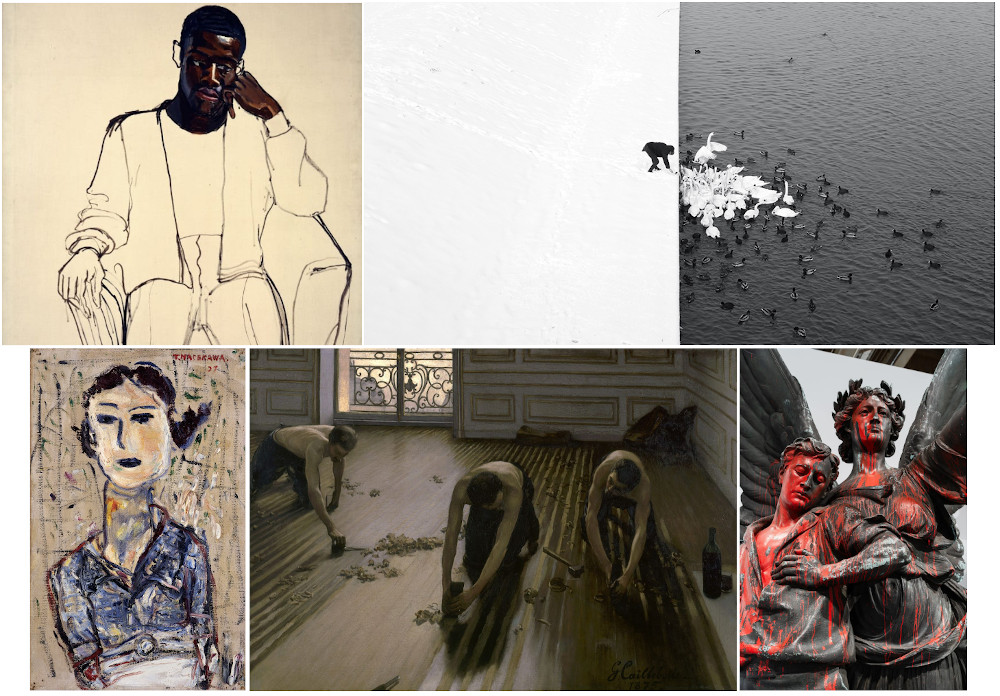
Images for the first week (January 5-11, 2026)
- Marcin Ryczek, “A Man Feeding Swans in the Snow” (2013). (Artist website, image located on this web page)
- Toshiyuki Hasekawa, “Girl of Noa Noa” (1937). (Google Arts & Culture)
- Detail of a monument sculpted by Frederick Wellington Ruckstull, on commission from the Maryland Daughters of the Confederacy. The sculpture was splashed with red paint during protests in 2017. Photo by Aleksey Kondratyev. (Image located in this New York Times article)
- Gustave Caillebotte, “The Floor Scrapers” (1875). (Image located in a Daily Art Magazine article)
- Alice Neel, “James Hunter Black Draftee” (1965). An unfinished work. (Image located, “#7,” in this Listverse article)

Images for the second week (January 12-18, 2026)
- Tamara de Lempicka, “Autoportrait (Tamara in a Green Bugatti)” (1929). (Wikimedia Commons)
- Félix Ziem, “Flight of the Pink Flamingos, Vaccarès Pond” (1890) (Artifair)
- Unknown photographer, “Duke Kahanamoku with His Redwood Surfboard” (ca. 1925) (Google Arts & Culture)
- Egon Schiele, “Couple Embracing” (1911) (The Met)
- Laocoön Group (Museo Pio Clementino)

Images for the third week (January 19-25, 2026)
- Claude Cahun, “I am in training, don’t kiss me” (1927) (Obelisk Art History)
- Peter Lindbergh, [Linda Evangelista, Tatjana Patitz, Christy Turlington, Estelle Lefébure, Karen Alexander, Rachel Williams for Vogue US, Los Angeles] (1988) (Daily Art Magazine)
- Egon Schiele, “Couple” (1909) (Schiele & Klimt: The Art of Secession and Beyond [blog])
- Tracey Moffatt, “Touch” from the series “Body Remembers” (2017) (on web page of Roslyn Oxley9 Gallery, Sydney)
- Mark DeLong, “Shared wing” (January 17, 2021) (Second Act—Re:Tooling)

Images for the fourth week (January 26-February 1, 2026)
- Emmet Gowin, “View of Rennie Booher’s house. Danville, Virginia, 1973” (Emmet Gowin: Photographs)
- Brassai, “View of Paris from Note Dame, toward the Hôtel-Dieu and the Tour Saint-Jacques” (1933) (Daily Art Magazine, top photograph)
- Théodore Géricault, “Study of the Model Joseph” (ca. 1818-1819) (Google Arts & Culture)
- Tarsila do Amarai, “Autorretrato ou Le manteau rouge” (1923) (Google Arts & Culture)
- Egon Schiele, “Seated Couple” (1915) (Google Arts & Culture, via Wikimedia)
A form of ekphrasis, but more I hope
The project follows a long tradition of using words to capture art. Ekphrasis is the Greek term for a rhetorical device, basically a vivid description of an artwork, a thing in the world, an experience. Plato used the device in his Phaedrus. Ekphrasis quite naturally has been practiced ever since. My January project follows the tradition, but I think it also extends it. The words that the daily writing will produce will not entirely be tied to a single image or artwork. Although I haven’t begun writing, I can see in the images that I’ve gathered certain cross-talk and conflict along with some accord and familiarity. I think that the images will converse in a fashion, perhaps merely by the circumstance of sequence even though the individual images may be historically separate by centuries. This kind of juxtaposition has its predecessors, the most famous and inventive being Aby Warburg’s Mnemosyne (1927). But my choices were far more haphazard than Warburg’s, the interplay of the images much less a matter of careful thought than his were.
Within the past year or two, a quiet movement has grown that seeks to slow down the ways we “look” at art. it is part of a more general interest in regaining strengths of attention. And it certainly has merit: museum visitors spend an average between 15 and 30 seconds of time looking at artworks. That’s something, but it is far too little to see the nuance and richness of art. The New York Times published a series beginning in July 2025 that asked readers to spend ten minutes with an image—the first of the series was Whistler’s “Nocturne in Blue and Silver” (1871). The authors, Francesca Paris and Larry Buchanan, were surprised to see that about a quarter of them did, judging from the data collected about the page on the web.
As I continue with the project, I will probably spend more than ten minutes with each image.
The writing “products” of the effort will no doubt be drafty—probably horrendously so. I won’t be sharing the work, but some of the pieces will end up revised and polished (if they have any “diamond-in-the-rough” in them). Perfect sonnets they won’t be when I end a day with them. With luck some will come to shine in the future.
Links, cited and not, some just interesting
“Ekphrastic Challenge,” Rattle Poetry, https://rattle.com/page/ekphrastic/.
Francesca Paris and Larry Buchanan, “Test Your Focus: Can You Spend 10 Minutes With One Painting?,” The Upshot, The New York Times, July 20, 2024, https://www.nytimes.com/interactive/2024/07/20/upshot/attention-experiment.html; and Sarah Bahr, “Can You Stare at a Work of Art for 10 Minutes?,” Times Insider, The New York Times, November 9, 2025, https://www.nytimes.com/2025/11/09/insider/10-minute-challenge.html.
“Slow Looking,” The Museum of Modern Art, accessed January 4, 2026, https://www.moma.org/visit/itineraries/slow-looking; and “Slow Looking How-Tos,” National Museum of Women in the Arts, 2020, https://nmwa.org/wp-content/uploads/2020/05/slow_looking_how-tos_2020.pdf.
Molly Kalkstein, “Aby Warburg’s Mnemosyne Atlas: On Photography, Archives, and the Afterlife of Images,” Rutgers Art Review 35 (2019): 50–73; https://rar.rutgers.edu/wp-content/uploads/2020/04/Vol-35-full-volume.pdf


