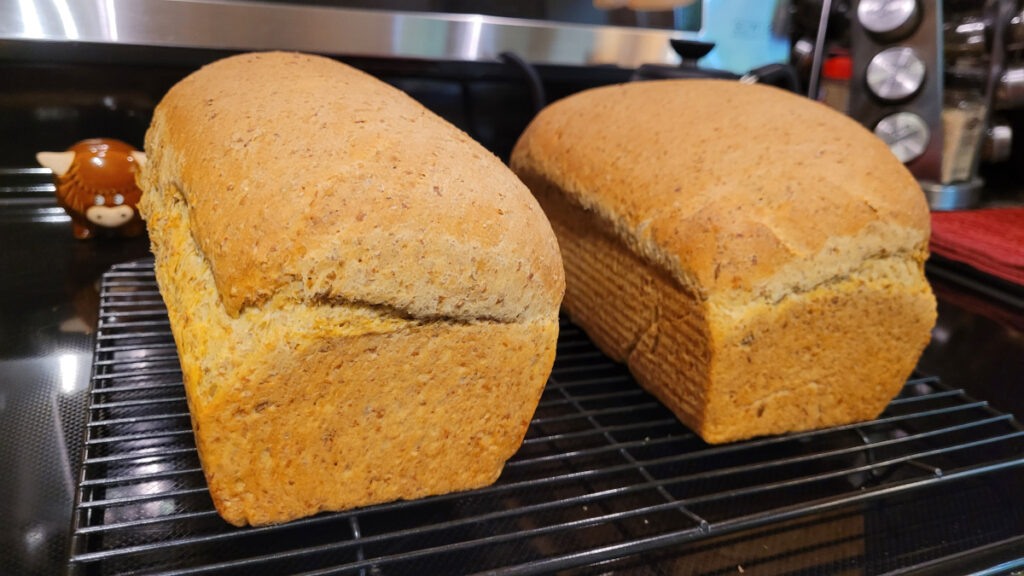
This year, I resolved to “perfect three breads.” This is the first one, tweaked and tested over the past eight months. The variations were many; the final decision, difficult. I offer variations at the end of the recipe, since you might like to tailor the bread to your tastes. This recipe makes two nice loaves, tasty, moist, and somewhat dense but not overly so. It’s perfect, especially since it admits variety, too!
Ingredients
2 cups (475 ml) lukewarm water
3 cups (710 ml) pumpernickel flour
3 1/2 to 4 cups (825-950 ml) all purpose flour
1/4 cup (60 ml) sugar (see “Variations” below)
1 tablespoon (15 ml) salt
2 1/4 teaspoons (10 ml) active dry yeast
2 tablespoons (30 ml) wheat gluten
2 tablespoons (30 ml) caraway seeds (see “Variations” below)
1/4 pound (115 g) melted butter
1 cup (235 ml), or so, mashed sweet potato (see “Variations” below)
This dough is very kneady! Because of the kneading requirements for this bread, I suggest using a dough mixer. Ours is a heavy-duty Kitchenaid fitted with a dough hook. It is possible to make the dough without a machine, but I’d suggest some gym training time to build up your arms. Because rye flours are low in gluten, you really have to knead the heck out of the this dough to build up the gluten so that the dough rises well. I run my Kitchenaid at least ten minutes—probably more like fifteen minutes—to get the dough right. Arm-wrestling the dough in old-fashioned hand kneading would probably take twice as long (and would probably be a good work-out).
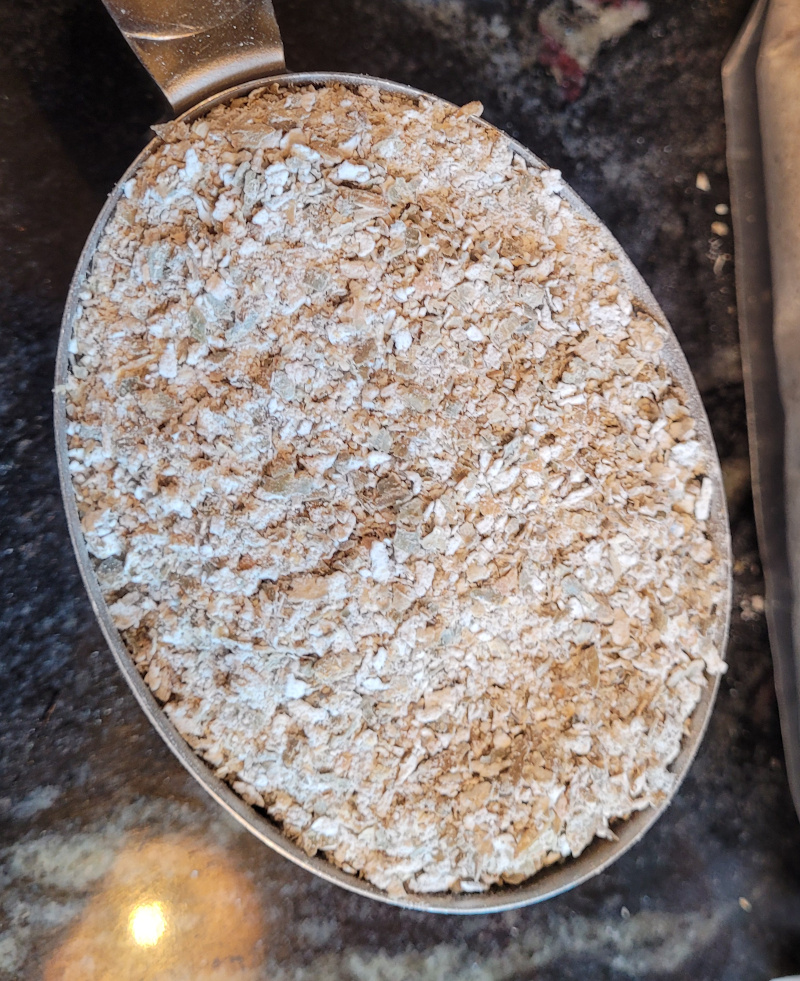
On flour brands. Some recipes push specific food brands, and I’ve been suspicious about payola in the background. I’m pretty agnostic about brands, though I do have preferences. King Arthur offers good all purpose flour, though I have found that their rye flour offerings are a bit over processed for my taste. King Arthur pumpernickel flour is finely ground and is indistinguishable, by texture at least, from the company’s rye flours. I prefer a rougher pumpernickel texture (so you can easily see the coarsely ground husks and germ), and I’ve used flour from other millers. Currently I’m using pumpernickel from Bakers Authority—initially because I knew it was coarsely ground, came in five-pound quantities, and the company has been around for a long time, since 1917. I think I’ll be sticking with them as a pumpernickel supplier, even though their shipping charges seem a bit high.
Instructions
Mix the lukewarm water, sugar, salt, yeast, caraway seeds, and pumpernickel flour in a mixing bowl. I just use my Kitchenaid mixer bowl for the whole dough mixing and rising process. Let the mixture sit for twenty minutes to allow the pumpernickel flour to moisten. For some reason rye flours—pumpernickel in particular—are slower to absorb water than wheat flour.
While the dough mixture is resting, cook a sweet potato in the microwave. Perforate a medium-sized sweet potato by stabbing it many times with a fork, wash it, wrap the wet potato in a paper towel, and stick it in the microwave on high for three or four minutes. Then after that’s done, I flip the potato over and microwave for another three minutes or so. (Your Mileage May Vary on the times.) The potato should be soft. Scrape the meat of the potato onto a plate, and mash it so that it resembles regular ol’ mashed potatoes. On occasion, I’ve had to add a bit of water to get to that consistency. A medium-sized sweet potato yields about a cup, which is enough for the recipe. (I’ve found that you don’t have to be fastidious about the quantity.) While you mash the potato, soften the butter in the microwave. My microwave does the trick in 44 seconds.
Add the mashed sweet potato and the melted butter to the flour mixture after it’s rested for twenty minutes.
Using the mixer fitted with a dough hook, mix the flour-potato-butter mixture for a couple of minutes so that it is well blended. Add the wheat gluten and 3 1/2 cups of all-purpose flour and start the mixer again. Let it mix for five minutes or so. You’ll probably find that the dough remains quite sticky, and at times some of the dough remains in a blob at the bottom of the mixing bowl. If that is the case, gradually add flour (about another 1/2 cup) until the dough no longer sticks to the bottom of the bowl. I have used a silicone spatula to loosen the stickiest dough from the bottom on the bowl, and it seems to mix happily after that. The dough should remain sticky, as rye doughs tend to be stickier than wheat-flour doughs.
Let that mixer run for another five to ten minutes. The mixing will allow gluten to form, and the bread dough will rise more easily into a nice loaf.
Remove the dough from the mixing bowl (you will likely need to use a spatula to get it out), and lightly oil the bowl. I use a smidgeon of olive oil to grease it up. Form the dough into a ball, put it into the oiled bowl, flip the dough ball over so that its top is lightly oiled, and cover the bowl with a clean towel. Let the dough rise until it is about doubled in size, about an hour. I used to let the dough rise in a slightly warm oven. That does speed things up, but it also makes the bread rise rather quickly after you make the loaves, which is the next step.
When the dough has risen, dump the dough onto a clean countertop. Divide the dough into halves, and shape the halves into loaves. Place the loaves into greased bread pans (I use butter, because butter is good!). Let the loaves rise until the dough touches the sides of the bread pans. Preheat the oven to 375 F (190 C). By the time the oven is preheated, the loaves will be ready to bake.
Bake the loaves for 30-35 minutes, until beautifully browned. Remove the loaves from the bread pans, and allow to cool on a cooling rack. I generally freeze one of the loaves, but if you do that, remember to allow the loaf to cool completely before bagging it.
Variations
Since I was in search of a “perfect bread,” this recipe has gone through many, many variations. Experimentation was critical to the process. I relied on one basic truth about bread baking: it is very hard to screw up. If you fail in some way, you usually end up with something delicious. None of the more than forty loaves I baked to develop this recipe ended up in the trash bin. My initial forays into this recipe started with a single large loaf of pumpernickel and sweet potato bread, without caraway seeds but laden with raisins and coarsely chopped walnuts. It was bread baked in a dutch oven, and it, too, was delicious. And the variations were plentiful, sometimes radical departures, other times subtle tweaks.
For variations of this recipe, I suggest changing the caraway seed amount to fit your taste. I like lots of ’em, but you might not. Dial them back, if you wish. For me, rye breads are associated with the smell and taste of caraway seed, and I might try crushing some of the seeds in the future, just to give the bread a bit more flavor. Not everyone likes to use sugar, though this bread isn’t particularly sweet and some (much?) of the sugar is digested by the yeast. You’ll probably need some sugar in the recipe to satisfy the yeast buds if not your taste buds, but you can go with less, or you can substitute honey or molasses. I have used both; molasses is nice in this bread, too.
Of course, you can toss in raisins and walnuts as you wish. Experiment! Make this your own!
Another variation, which shall henceforth be called the Misha Variation, has to do with the sweet potato. Misha told me that he inherited his father’s disgust of sweet potatoes, so a simple variation (though I think regrettable, alas) is to use regular old Russets. The potato does add some richness to the dough, it seems. This recipe isn’t particularly sweet-potato-y, actually—you wouldn’t know it’s in there if you weren’t told. I use sweet potato to provide a hint of flavor and to lower the carb count of the bread—though, be warned, this isn’t a “lite” bread.
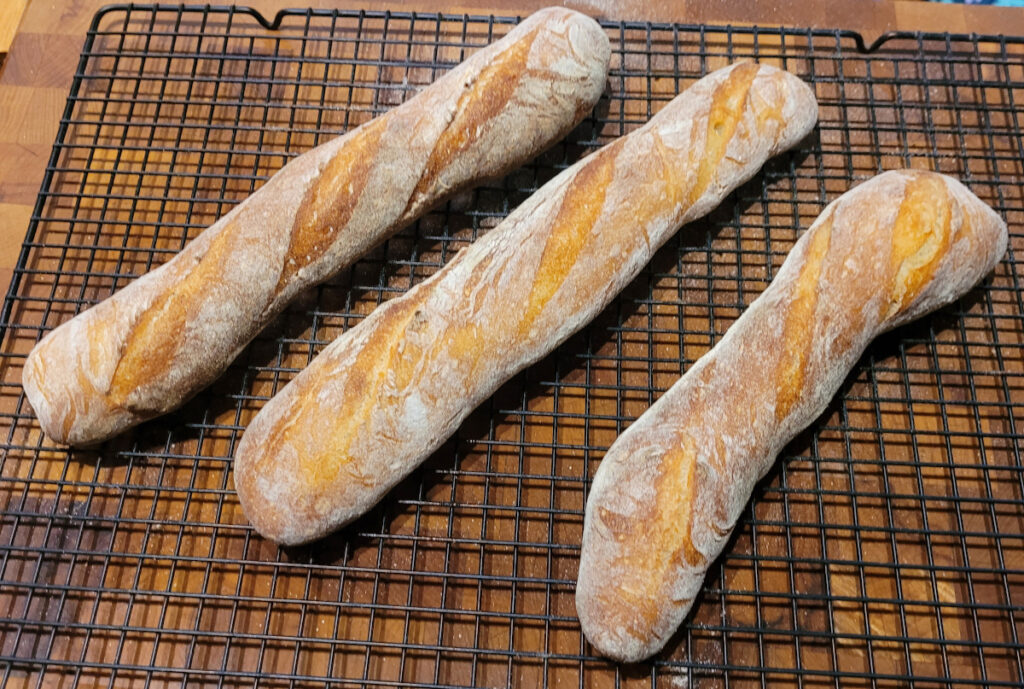
I have begun on a quest to master baguettes, a type of bread so perfect already but also hard to bake. It’s going … okay, but it’ll be a challenge to count my baguettes among the perfect loaves of the breed. They are beginning to look like they should (see below). More on that quest later, I promise.