My seminar on “Our Complex Relationships With Technology” brought me back to a post of a couple years ago and to one of the discoveries that I gathered for my year-long “Boulangerie” project. I was searching for concrete illustrations of the influence—and even deceit—that technologies press on our experience.
The old post featured Roger Fenton’s two versions of his “The Valley of the Shadow of Death” photograph, famous because of where cannonballs appear, on or off a road winding through barren Crimean hills. (You can see the two photos below, by the way.) The piece from the Boulangerie was a curious digital photo taken by an iPhone and posted by Tessa Coats on Instagram (November 4, 2023). It was not “photoshopped,” she claimed.

Another photo came to mind as well: Louis Daguerre’s “first photo of a human being” from 1838, when Daguerre trained his camera lens on the Boulevard du Temple in Paris one morning around 8:00. It was a busy street, but the long exposure erased the traffic. The exposure was probably four or five minutes—just long enough for the gentleman in the lower left, near the curve of the street, to have his shoe shined—and to become the first person captured in a photograph.
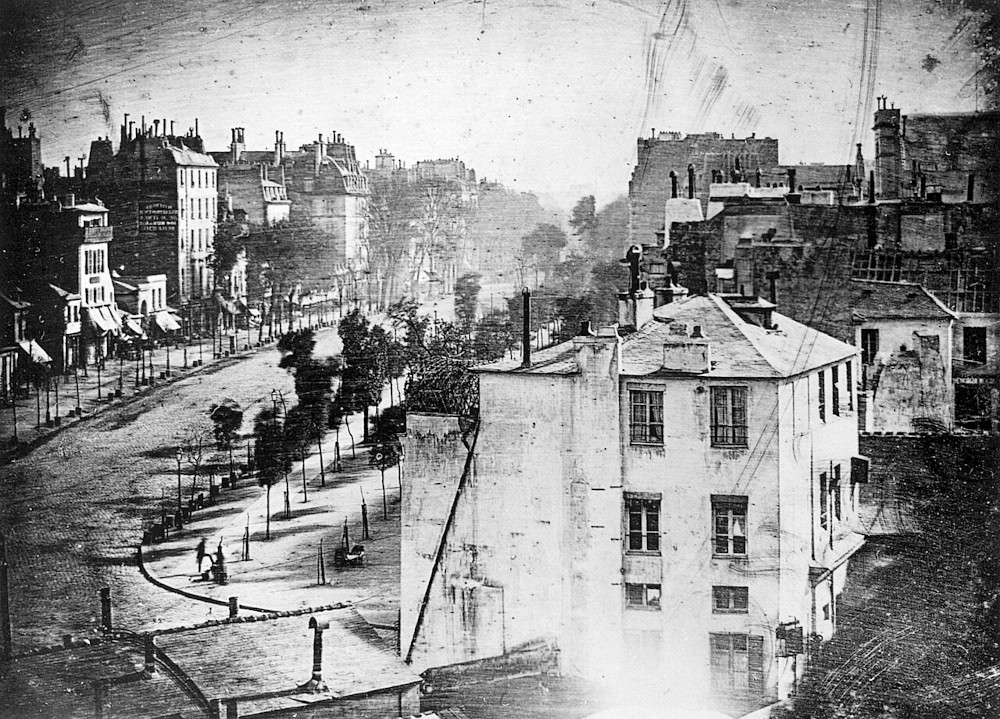
These images show the limits and the capabilities of their originating technologies. The Fenton images show how manipulation can play with photographic storytelling, too. As we went through the images one-by-one in the seminar, we could see the changes and tease out some characteristics of their underlying technologies. But what interested me especially was the way that doing the exercise also revealed assumptions that students held when they considered a photograph: primary among them, how photography is evidence of truth. Close consideration of the photographs qualified that main assumption.
We wound up discussing truth, fakes, and fiction.
Links, cited and not, some just interesting
Includes a description of the algorithmic workings of Apple’s iPhone camera, and how an app “fixed” the Apple camera’s machinations: Chayka, Kyle. “How I Fell Back in Love with iPhone Photography.” The New Yorker, October 16, 2024. https://www.newyorker.com/culture/infinite-scroll/how-i-fell-back-in-love-with-iphone-photography.
“ ‘When you take pictures, make sure you get pictures of all the time-sensitive things in your house,’ [Daniel Dennett] told me; that way, your future self could say, ‘THIS was our car, this was our television set, this funny thing is called a dishwasher.’ When he looked at photos from his youth, he wrote, it was ‘often the startled recognition of a long-discarded plate or chair or vacuum cleaner’ that fascinated him—not ‘the pictures of little me.’ ” Rothman, Joshua. “What Can You Learn from Photographing Your Life?” The New Yorker, October 22, 2024. https://www.newyorker.com/culture/open-questions/what-can-you-learn-from-photographing-your-life.
Image credits: Coates, Tessa. “Tessa Coates on Instagram: ‘Okay Hello! Upgraded from Stories to the Grid. I Went Wedding Dress Shopping and the Fabric of Reality Crumbled. This Is a Real Photo, Not Photoshopped, Not a Pano, Not a Live Photo. If You Can’t See the Problem, Please Keep Looking and Then You Won’t Be Able to Unsee It. Full Story in My Highlights (THE MIRROR) Please Enjoy This Glitch in the Matrix/Photo That Me Nearly Vomit in the Street ❤️ 💒 Also, I’m Engaged! 💍.’” Instagram, November 4, 2023. https://www.instagram.com/p/CzPGNmJIebC/.
Daguerre, Louis. Boulevard Du Temple. 1838. Daguerreotype photograph. Wikimedia Commons. https://commons.wikimedia.org/wiki/File:Boulevard_du_Temple_by_Daguerre.jpg. Rights: Public domain.